
Electronic stethoscopes
Amplified electronic stethoscopes for auscultation in noisy environments or on obese patients. 18× to 40× amplification, ambient noise filtering and audio recording for telemedicine.
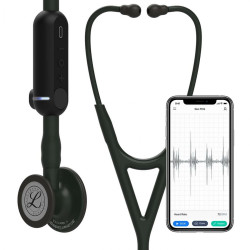
Eko Core 500 connected digital stethoscope with ECG function
Reference : EKO0001Amplified stethoscope, Bluetooth connectivity with 3-lead ECG function.
CLASSIC stethoscope case
Reference : GIMA0002 Available in 3 colours.Ear tips for Eko Core 500 stethoscope, 3 colors
Reference : EMBAURPOUSTÉ735 Compatible only with the Eko Core 500 stethoscope.Eko Core 500 protective ear case - 3 colors
Reference : EKO0020 Compatible only with the Eko Core 500 stethoscope.3M Littmann CORE Digital Stethoscope
Reference : LITT0115 High-performance digital stethoscope offering precise amplification, active noise reduction and optimal comfort for reliable auscultations on a daily basis.Amplified Electronic Stethoscopes
Electronic stethoscopes represent a major advancement in medical auscultation. By converting acoustic sounds into electronic signals, they enable powerful amplification, filtering of ambient noise and advanced features such as recording, visualisation of phonograms and remote transmission. This technology is increasingly being adopted by cardiologists and doctors practising in noisy environments.
Amplification and ambient noise filtering
The main advantage of electronic stethoscopes is their ability to amplify body sounds by 18 to 40 times compared to acoustic models. Digital filtering of ambient noise makes it possible to isolate heart and respiratory sounds even in the noisiest environments – ambulances with sirens, A&E departments with multiple audible alarms, and intensive care units. For doctors with mild hearing loss, the electronic stethoscope can extend their ability to practise clinical medicine.
Recording and telemedicine
Some latest-generation electronic stethoscopes feature the recording of auscultatory sounds and their transmission via Bluetooth to a smartphone or computer. This feature paves the way for teleauscultation – a remote practitioner can listen in real time to a patient’s heart and lung sounds – and for artificial intelligence to aid in the diagnosis of heart murmurs. These tools reach their full potential in the context of cardiological telemedicine.